Daspos: The Danish duo who taught ships to spot trouble in the air
It all started with a common maritime safety challenge: oil mist, engine-room risks and spotting minor issues before they escalate.
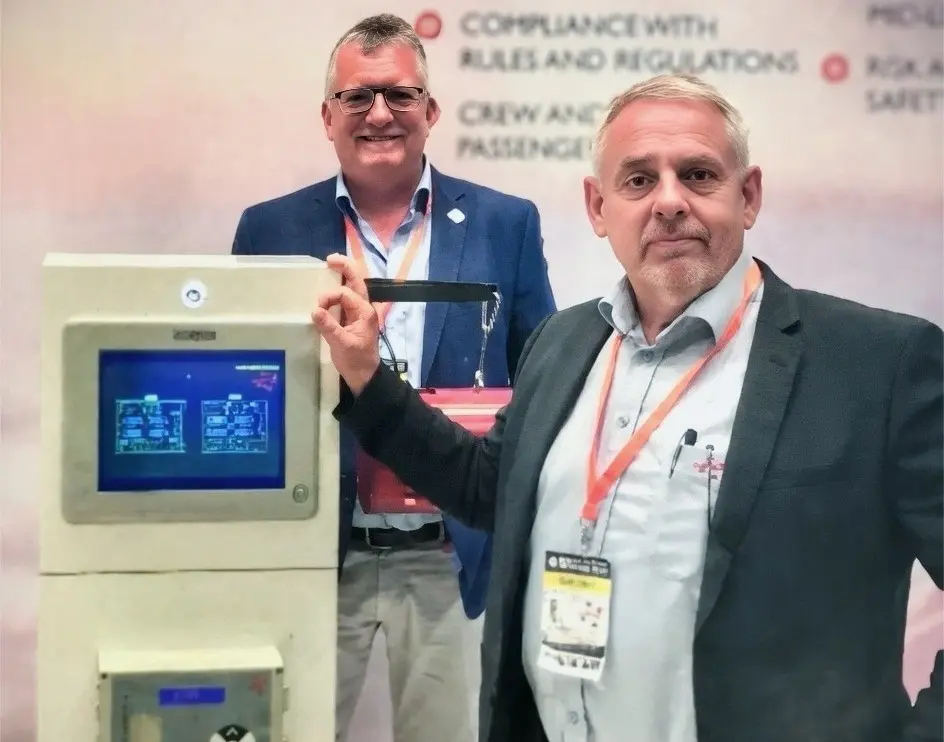
Torben Jørgensen and Lars Gerner Lund developed a system to spot anomalies early, driven by the belief that crews should understand what keeps them safe.
“You’re muted, Lars,” Torben says, passing along the question about years in the industry and how it has changed.
Lars unmutes: “Regarding Daspos, it started 16 years ago, in 2010. Before that, Torben ran some tests,” Lars says, pausing briefly.
“Maybe you should start there, Torben,” Lars suggests, pronouncing Torben very Danish, which sounds closer to Tom.
The way they tell their story is itself a blueprint for Daspos: cheerfully informal, utterly practical and clear about each person’s role.
Torben Jørgensen began testing around 2005, after years of selling traditional oil-mist detectors for large diesel engines. What came next defined Daspos: it improved safety at sea with patented sensors that spot fire risks in ship engine rooms by detecting vapours and oil mist early.
The work took time and financing was a big challenge. Torben kept himself going with a personal ultimatum.
“I spent too many years developing the system. If I’m the last one who believes in it, I will stop”.
Fortunately for Daspos and maritime safety, others shared his conviction and joined the effort.
A grant from the Danish Ministry of Economics covered the patent search. Maersk’s first tests went well. Soon, the Danish Maritime Fund and local institutes also got involved, testing the system and giving their approval.
Maersk also influenced how the system was designed. They wanted oil mist detection everywhere in the engine room, but they also wanted it to be simple. Lars says the crew should be able to “put a hand on every component” and follow the system right up to the alarm. Torben sums it up: “No black boxes.”
The engineer and the supply chain man
By that time, Lars Gerner Lund had joined Torben. Lars is Torben’s brother-in-law and came from a different background: he worked in supply chain management at Danisco, which Lars describes as “Danish sugar and stuff like that.”
Lars handled the business side, while Torben took care of the technical work. “We have very different competencies,” Torben says.
“If I had started the company with another marine engineer, we would have missed many of the skills needed to run a business,” Torben adds.
Working with family has its ups and downs. “You cannot replace your colleague,” Torben says.
“You cannot leave and run away”, Lars fills in and jokes that this was not why he got divorced.
Then they faced the tough reality of the market. With no regulations demanding their system, selling to purchasing departments proved futile. Instead, they had to convince shipowners and technical experts who truly understood the risks in engine rooms.
The cruise industry also influenced demand, as major incidents highlighted the necessity of their system.
They faced another problem: nobody knew them. “We had no name and no network,” Torben says.
To make things harder, people confused Daspos with Danfoss or thought it was a plumbing company. “It was uphill,” Torben says.
Proof of concept
Their breakthrough occurred in Esbjerg, where an offshore support company that had used a competing system on over 40 ships considered their solution.
After a short meeting, the company switched its whole fleet. “That was a really good day,” Torben says. It was one of the first real signs that their product could succeed.
Daspos earned trust by being very hands-on. Lars says that they put the systems together, test them, take them apart, ship them, and then reinstall them on the ships.
“We didn’t feel that we had room for failure,” Lars says.
As a small company, they could move fast. If something came up, they discussed it “across the aisle” (or the dinner table) and acted immediately. They did not wait for layers of management.
“Customers started to see us as fast and reliable,” Torben says.
Lars leveraged this confidence into a sales strategy. For larger customers, Daspos installed the system and sent two invoices: one for the equipment and one for the installation.
If the customer liked the system, they paid for it. If not, the merchandise invoice was credited and they paid only for the installation.
Daspos gave the customers eight weeks to decide. “We believe in our products,” Lars says. Not a single system was ever returned, which in the shipping world is like getting a standing ovation.
Torben remembers the first installations, when he had to explain every component. Over time, crews told him, “We know the system. You don’t have to explain.” For him, that was real recognition from the industry.
There were even stronger endorsements. Some customers said that without DASPOS, they might have had an engine explosion or a fire.
By 2017, Daspos was making steady profits and had become a Danish Gazelle company, growing its revenue by 3,700 per cent. That success brought them more attention.
A Bigger Network
But scaling up was a whole new challenge. While Daspos remained agile and technically sharp, it lacked the sales muscle to push much further on its own.
At this stage, Consilium Safety Group got involved. In 2024, Consilium acquired Daspos and fully integrated the company into its operations.
Consilium viewed Daspos as an opportunity to enhance its portfolio with proven fire-prevention technology and broaden its presence in maritime safety.
For Daspos, the acquisition offered access to a wider sales network and the scale needed to bring their systems to more ships worldwide, ensuring the technology can have an even greater impact.
Lars says it became easier to talk to customers because Consilium already has the sales team, network, and reach for all types of clients.
Torben declared with emphasis, “Consilium was the best partner for us.”
Still on the radar
At the start of the call, we discussed their plan to step back. I wonder aloud whether they might keep going for another ten years.
“Yes, maybe,” Lars says. “But let’s start with the first one.”
They laugh, but neither of them is truly sold on the idea of retirement.
Later, Lars provides a more pragmatic perspective.
“That’s what we’re supposed to do, so let’s see where it ends”.
But Daspos will always be on their minds.
“We will follow Daspos,” Lars says. “I promise you.”
Torben is looking forward to a real summer holiday, with his laptop closed and maybe even leaving his phone behind. After that, they plan to share what they’ve learned and then “just do what is fun”.
Torben points out that this is how Daspos started too. The company was created to solve a serious safety problem in shipping, but the work needed to be enjoyable to last.
“It has to be fun,” he says with a smile. Lars nods, as if that had been as important to Daspos as its sensors and wiring.