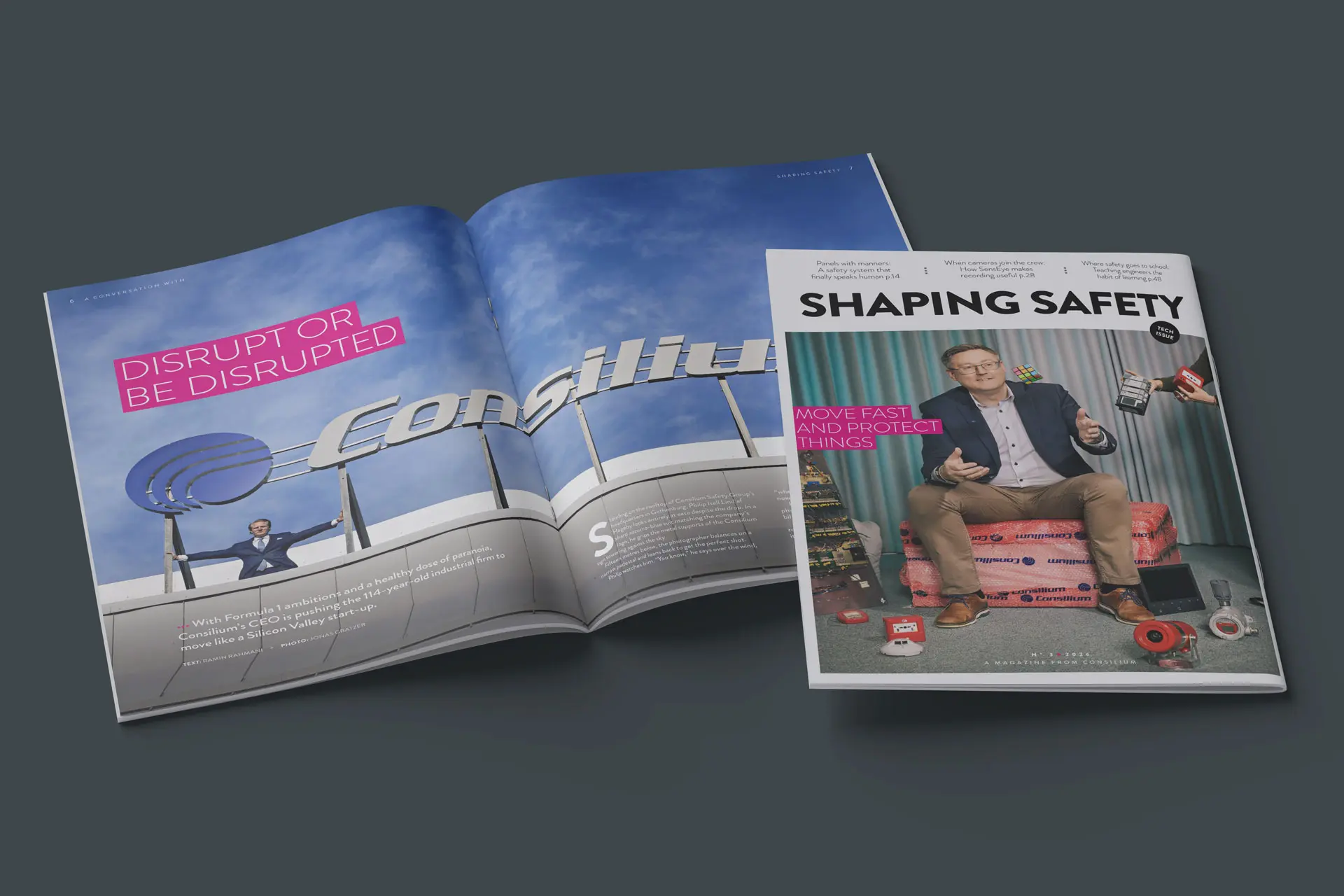
With Formula 1 ambitions and a healthy dose of paranoia, Consilium’s CEO is pushing the 114-year-old industrial firm to move like a Silicon Valley start-up.
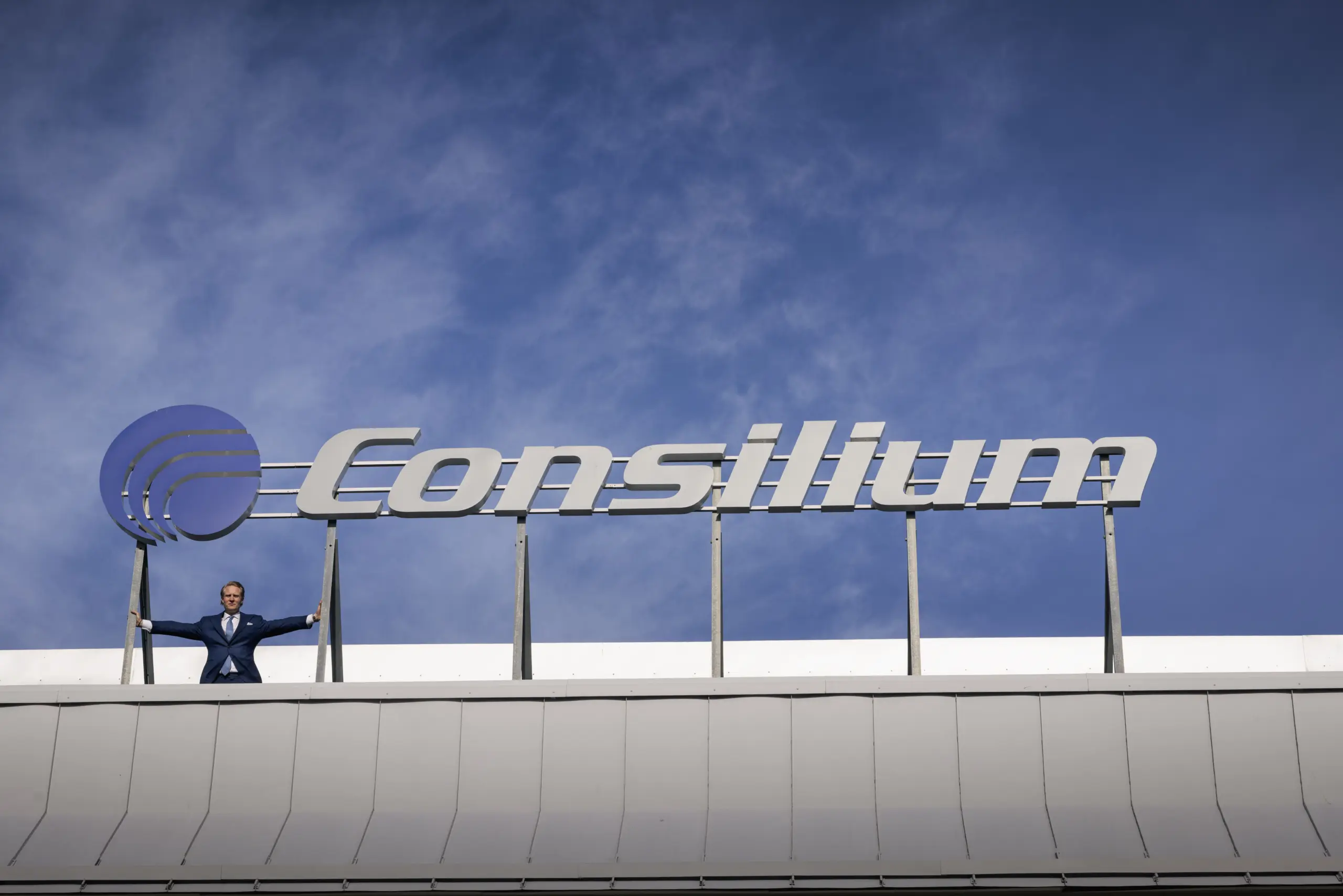
Standing on the rooftop of Consilium Safety Group’s headquarters in Gothenburg, Philip Isell Lind af Hageby looks entirely at ease despite the drop. In a sharp azzurro-blue suit matching the company’s logo, he grips the metal supports of the Consilium sign towering against the sky.
Fifteen metres below, the photographer balances on a narrow pedestal and leans back to get the perfect shot.
Philip watches him. “You know,” he says over the wind, “where he is standing is probably much riskier than where I am now.”
His casual remark cuts straight to the core of his philosophy: to outpace the industry without losing sight of the possibilities worth pursuing.
Founded in 1912, Consilium operates in the marine, energy, rolling stock, and critical infrastructure sectors, where reliability is non-negotiable, and systems are built to last.
In four years under his leadership, Consilium has doubled its size. Yet Philip’s ambition to lead in Safety Tech drives the company at a pace he calls ‘testing the laws of nature’.
“We are always pushing the limits of what we can achieve in speed and impact,” Philip says once we are seated in a glass-walled meeting room.
“It’s easy to compare yourself to last year, last quarter, or your previous product. We rather look at industry neighbours and focus on what the full potential performance could be if all stars were aligned,” he says. “Companies with similar characteristics but a better pace and performance.”
Breaking bottlenecks
His approach is to break processes into parts, identify bottlenecks, and fix them. He illustrates this with a Formula 1 analogy.
“If a car’s speed is limited by one component,” he says, “you do not accept the limit. You replace the part, redesign it, or find a way to cut it out entirely.”
“We do the same with our work,” he says. “If developing a product took a year before, why shouldn’t it take six months now?”
I push the Formula 1 analogy a step further and mention Dutch world champion Max Verstappen, who recently complained about new regulations and hinted he might quit racing.
If we put ourselves in his shoes, how flexible does Consilium need to be when technology shifts or new regulations change the game?
“He might want to quit because others are catching up and winning is not as easy anymore,” Philip says.
“But the point is this, humans have an amazing ability to adapt. Even under pressure and tight deadlines, people still get the job done. They find ways. You remove slack. You remove inefficiencies.”
He moves the analogy from drivers to the regulations that guide them.
“New rules don’t just appear suddenly, they come after long talks, negotiations, and compromises.”
For Philip, adaptation alone is not enough. He believes Consilium should help shape industry changes.
“We should ideally be influencing these regulations. We must be in the forums. We always say that we love regulations, and we do, but we make sure we stay one step ahead so we can drive them in a direction that creates the best safety for our customers.”
He does not see technology as the main barrier. “If we hit a wall, it usually means we have not pushed ourselves far enough.”
A productive paranoia
To avoid limits, Philip says Consilium needs to notice details that might seem unimportant at first. That instinct stems from what he describes with a slight smile, tapping his head:
“Call it my own paranoia,” he says, looking briefly at the empty chairs around the conference table as if checking for intruders. “I see ghosts everywhere.”
“If we keep thinking about how to disrupt ourselves,” he says, his tone turning more serious, “I am convinced no one else will disrupt us.”
It is a mindset that has changed how Consilium sees itself. “We used to act as a steady, traditional industrial company. Now, we move with the energy of a start-up.”
He gives a broader example and remembers Steve Ballmer laughing at the first iPhone because it didn’t have a physical keyboard. The lesson is that being too sure about today can make you miss how fast things change.
“If you only focus on the two or three pixels in the middle of a picture, you will miss what the larger image is actually becoming,” he explains.
Philip mentions the company’s work with wireless detection technology and its investments in AI-based camera detection. Both, in different ways, sit slightly to the side of what a more cautious company might define as the core business.
“We need to get into these cases, even if they seem indirect or less relevant. We have to understand how they work, how they connect, and where potential challengers might come from.”
The payoff, he suggests, rarely appears where the work began.
“What usually happens is that we cook up something entirely new. A failed experiment might lead to a different technology, and eventually, we have a brand-new product. Success often arises from unexpected innovations and the freedom to experiment.”
He points to SMiG, Consilium’s interactive safety management system, which was already in place when he arrived. “We reworked, refined and made it easier to install, more modular and with an unparalleled user interface.”
It took time for both the company and the market to fully accept it.
”Now it is the best thing that has happened to us, he says”.
Trusted adviser
When it comes to customers, he is direct. Everything Consilium builds is for them, and guiding them towards better, safer solutions is at the core of the work.
“Our customers carry real responsibility”, Philip says. “They manage operations where failure is not an option. Naturally, they can be sceptical of new technology, and they should be.”
“Nobody should feel uncertain”, he adds. “We need to show them, step by step, how simple it really is, prove that it works, and provide ongoing support so they remain confident. If they are not, it is our fault.”
The conductor
As Philip keeps talking, we notice our planned thirty-minute chat has turned into almost an hour.
Before wrapping up, I ask him one last question.
How do you get over 1,200 employees on board when the pace starts to feel almost too fast?
“The first step is to make the future visible, he explains. “What should Consilium look like in a few years? The answer had to be concrete enough for everyone in the organisation to picture it”
“You should almost be able to see and feel the company in that target state,” he says.
From there, Consilium broke the work into clear initiatives, assigned responsibilities, and set priorities. They built the plan by starting with the future they wanted and working backwards.
He uses strategic terms like target state visualisation, value-creation plans, and must-win battles, but the process itself remains straightforward.
“People move faster when they know where they’re going, and even faster when they know exactly what part they’re responsible for,” he says. “If you’re clear about what you want to become, it becomes a self-steering company.”
His role now, he says, has also changed.
“Now I am more like the conductor, making sure everyone plays in time and at the same speed.”
Read more about Consilium here.