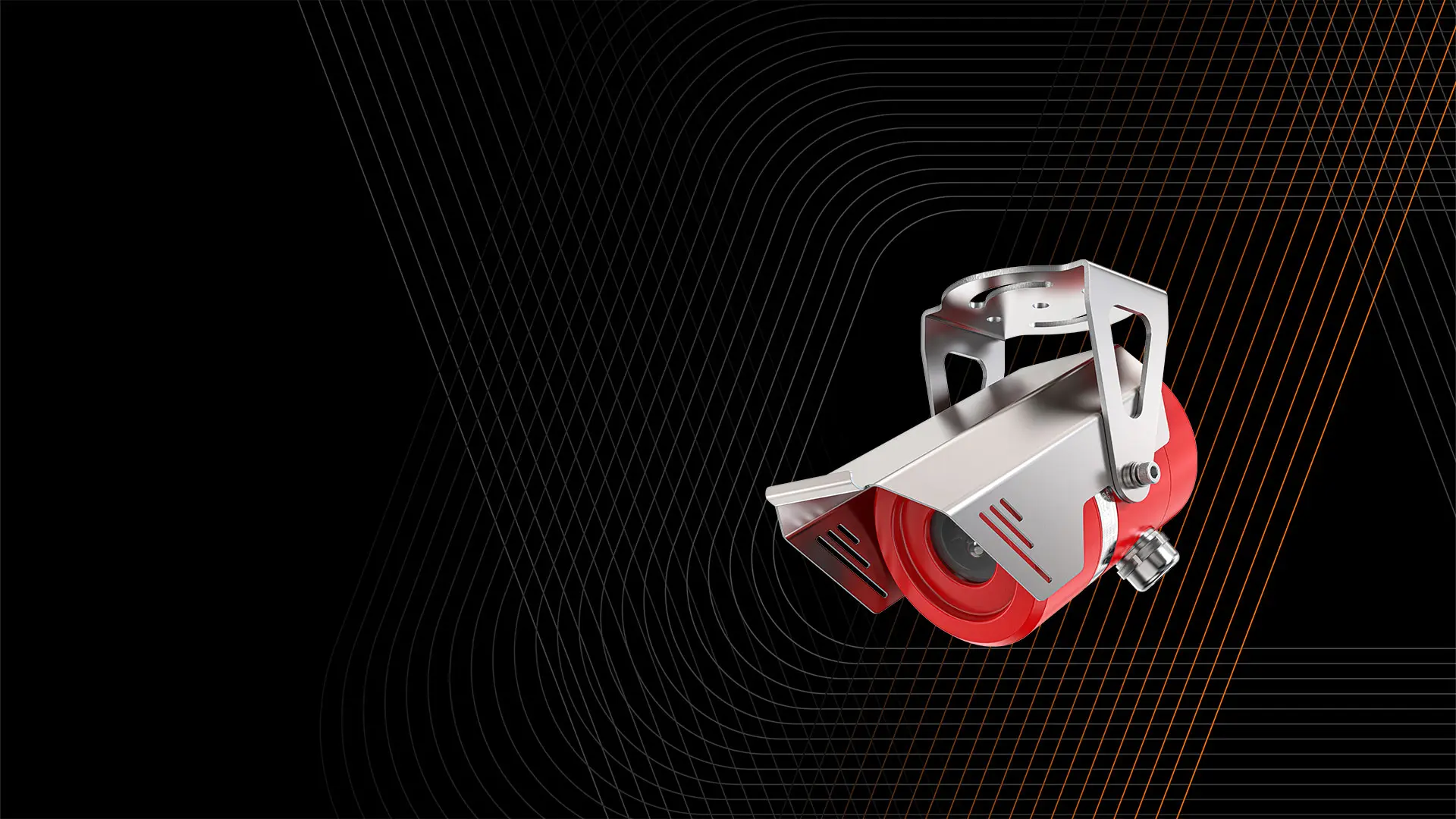
Put two of Micropack’s FDS303s next to each other and they look like twins. Pick them up and they most certainly do not. The stainless-steel version has the heft of a bowling ball. The aluminium one weighs less than half as much.
Both are powder-coated bright red, with a sapphire window at the front and strong screw threads at the back. The housing is built to contain an explosion set off inside its own stomach.
The enclosure design goes back over twenty years to the FDS301, which needed more space for its electronics. Over time, however, the electronics shrank while the enclosure stayed the same.
In an ordinary object, that wouldn’t matter much. In a flameproof enclosure, the free volume inside affects the explosion testing the housing must pass. Shrink the contents of a suitcase without changing the suitcase, and you are left carrying more air.
Micropack’s answer was a plastic filler, effectively replacing the volume that technological progress had removed.
“It was purely there to take up space,” says Matt Knox, Head of Product Line at Micropack.
The filler did its job. But eventually the team wondered: why not just remove the extra space and make the cylinder shorter?
There was a hitch. Shortening the enclosure meant going through certification again.
“It was an ‘if it’s not broke, don’t fix it’ type of thing,” Matt says.
Taking out the nothing
Matt and his fellow engineers kept pushing for a shorter enclosure. When another certification project came up, they spotted their chance.
“We kind of snuck it through and got FM to test it, maybe without having full approval from management,” Matt says, smiling. “It was a bit of a skunkworks project.”
It passed.
“Then we had to go and apologise for what we’d done,” he says. “But we do have this new product. And by the way, it’s going to be cheaper and cost less to ship.”
What they had done was stop manufacturing, transporting and paying for space they did not need.
The stainless-steel detector shed about 1.5 kilograms, the aluminium version around half a kilo. The plastic filler disappeared altogether. So did the Bulgarian leg of the build because that part no longer needed to be made there and shipped to Sweden for assembly. Even the enclosures arriving from Shanghai now weighed less.
“You get a good workout moving them around,” Matt says. “Removing 1.5 kilograms matters when someone has to lift one into position and install it at height”.
“That’s the approach we’ve pushed with the people actually installing it and commissioning it,” he says. “This is going to make your life easier.”
Then there is the box around the box. A smaller detector needs less packaging. More units fit on a pallet, warehouses can store more of them, and lighter shipments head out to customers.
“We’ve had only positive feedback from our customers,” Matt says.
After reading Consilium’s sustainability report, Graham Duncan, Managing Director at Micropack, began calculating the carbon savings from the metal and plastic they no longer needed.
A kilo or so may not sound like much. But across 9,000 FDS303s made per year, it adds up. The calculations show about 102 tonnes of carbon emissions avoided each year. For Matt, seeing that number changed how he thought about the redesign.
“You’re only saving half a kilo of aluminium, but you’re saving many kilos of carbon emissions, and it far outweighs the actual material itself,” he says.
“It’s mind-boggling, actually.”
What the number covers
For Sharareh Farshchiha, Global Sustainability Manager at Consilium Safety Group, the FDS303 calculation is a useful starting point. The weight of the missing material is only part of the picture.
“You have an emission factor per material, and when you multiply it by the weight of the reduction, you can calculate how much emission we are saving,” Sharareh says.
That factor changes based on how and where the material was made. If supplier data isn’t available, industry averages are used instead.
“The assumption is that everything stays the same,” Sharareh says. “No material is added, no change to the production process, and the same energy is used.”
In this case, nothing replaced what was taken out, and the detector kept the same performance and working life.
According to Sharareh, a full life-cycle analysis would go beyond the enclosure and look at the entire detector, its materials, how it’s made and used, and what happens at the end of its life.
She sees another use for the data. By adding carbon figures to the bill of materials, engineers can spot which materials have the biggest impact while there’s still time to adjust the design.
Back to the drawing board
The shorter enclosure is now used for the entire 303 range: the original detector, a hydrogen version built on the same platform, and a new UVIR device.
“It’s kind of opened our eyes to look at other things, to take a step back,” Matt says.
The next piece is the bracket. Micropack is working with a design agency on concepts using folded sheet metal, which means fewer separate parts to assemble. Graham says the goal is “as little design as possible” while keeping it functional, usable, and cost-effective.
For now, it remains at the concept stage. Sketches on a drawing board.
“We used to design the enclosure around the electronics. Now one of the first questions we ask is: can we physically fit the electronics inside this enclosure?” Matt says.
FDS303 – in brief
What is it? An infrared flame detector developed by Micropack for early fire detection in industrial environments.
How does it work? It monitors infrared radiation at three different wavelengths to detect fires involving hydrocarbon liquids or gases. The technology is designed to minimise false alarms.
Where is it used? In high-risk environments such as oil and gas installations, petrochemical plants, refineries, tank farms and road tunnels.
Protection and self-checks: A flameproof enclosure protects the electronics. Heated optics help the detector operate in snow, ice and condensation. A continuous optical check raises a fault when the detector’s range drops by half, indicating it needs cleaning.
Related versions: A hydrogen version detects hydrogen fires, and a UVIR version combines ultraviolet and infrared detection.
Weight: 2.5 kg (aluminium), 6 kg (stainless steel).