In safety, time matters. A false alarm wastes it; a missed one can cost lives. Consilium has a solution that sharpens both ends of that dilemma, turning camera feeds into reliable guidance.
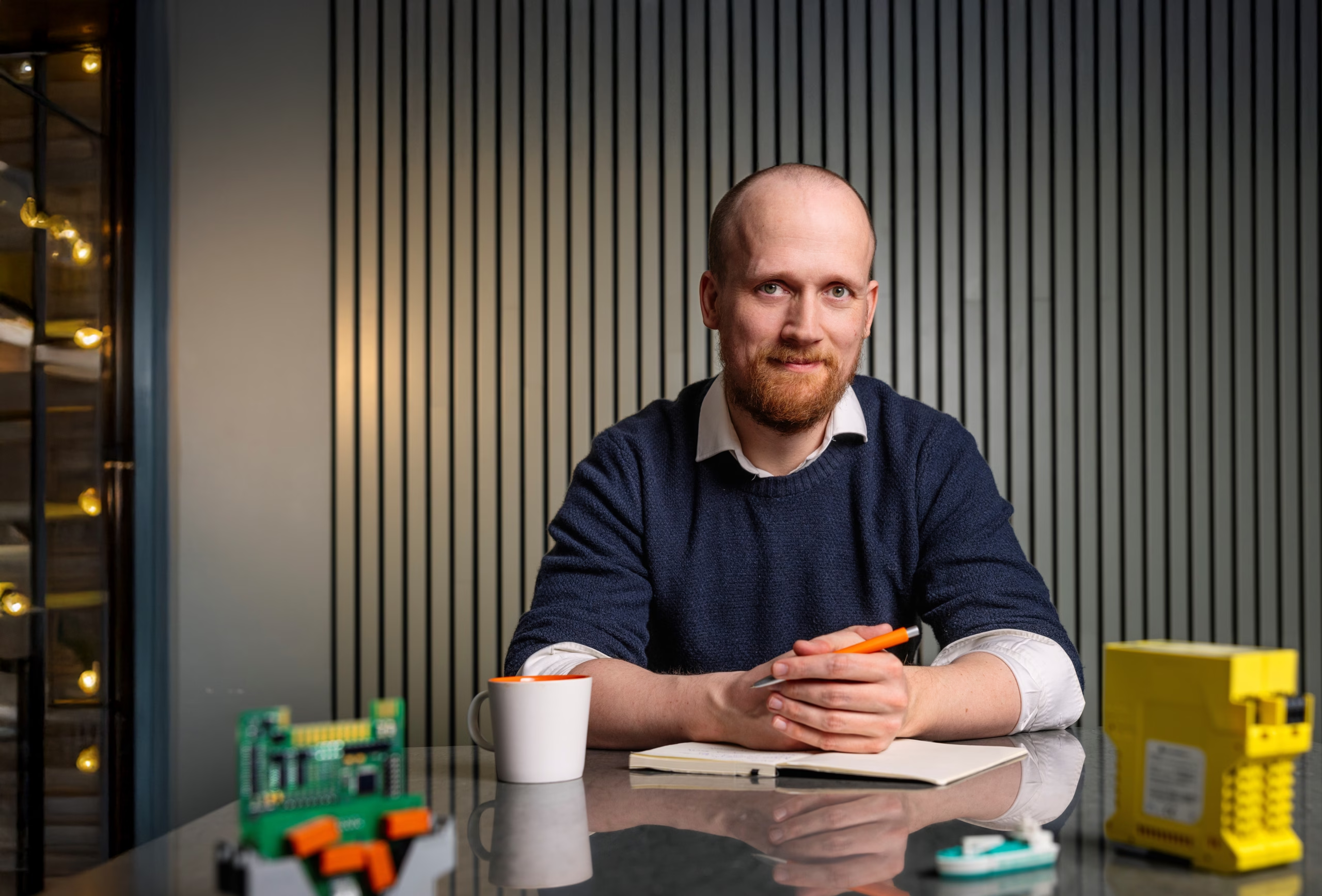
Isak Nordberg opens his laptop with the kind of enthusiasm usually reserved for unveiling a secret. While he jokes, “Now you can see my acting skills,” he is aware of the urgency crews face in real-time decisions.
A grainy video appears on the screen, showing him collapsing to the floor. He lies still for a moment, acting as a crew member who could experience this in a ship’s engine room.
The camera records the fall and raises an alert. A live feed then shows whether the person remains on the ground. In seconds, the crew has both the warning and the context to act.
The demo reveals SensEye, Consilium’s new safety solution that links cameras to SMiG, the company’s safety platform. Instead of just recording, cameras become the eyes of a network that reacts instantly, like body nerves.
According to the International Maritime Organisation, many incidents are traced to delayed emergency responses. SensEye represents a shift from passive surveillance to active monitoring in an industry where delayed responses can prove catastrophic.
To explain further, Nordberg stands up, takes a pen, and draws a comparison. “Think of it like a brain,” he says, sketching two halves.
Each half represents a function: fire detection, gas sensing, temperature monitoring, and oil mist detection. At the bottom, he adds SensEye, the newest feature. “It’s like our eyes built into the camera,” he says.
SMiG works as the brain, making sense of what the cameras see. Doors, alarms, and suppression units act as the hands that put decisions into action.
A CCTV camera only records, leaving someone in the crew to watch the feed and decide what to do. SensEye notices and passes the information to SMiG, which compares it with other sensors and provides the crew with a clear picture.
This way, the crew can decide whether to close a door or ignore a false alarm. “That’s the strength,” Nordberg says, “the system helps the crew act on the right things.”
Catching what’s missed
The same principle applies to equipment. A missing fire extinguisher, for instance, should be visible to a crew member but can be easily overlooked.
Here, SensEye picks it up through the camera and logs the absence. “For the crew, it cuts a step. Instead of walking the ship to check every station, they can focus on solving problems the system has already identified,” says Nordberg.
It can also support maintenance. “It might tell you it’s time to service something,” Nordberg says. “The camera has seen a condition that signals you should act before it becomes a bigger issue.”
He plays another clip. This time, the camera catches a wisp of smoke. The system flags it, then checks against other sensors in the fire detection network. If both agree, the alarm goes forward. If not, the signal is muted, sparing the crew a false alarm.
Nordberg stresses that SensEye is not a replacement for fire detection but a complement. They strengthen the ability to detect incidents early and identify conditions that could lead to them. “It might be an oil leak, something that could turn into one.”
Safety patterns
In another clip, a crew member walks past without a helmet. SensEye notices, but instead of plastering blame across the screen, it anonymises the face and logs the lapse.
“We’re not interested in pointing out that someone forgot their helmet,” Nordberg explains.
“Instead, our solution gathers statistics. Over time, those records turn into patterns: how often lapses occur, where they happen, and what measures might reduce them.”
The same logic can apply to passenger movement. “Cameras can raise an alert if someone enters a crew-only area, a feature several clients have shown strong interest in,” says Nordberg.
In an urgent situation, such as during an evacuation, if a stairwell becomes blocked and people stop moving, SensEye can send an alert in seconds. The crew can then redirect passengers before the situation becomes dangerous.
“In such moments, it might deliver many signals at once, but the aim is to turn that flood of information into clear guidance,” he states.
Each demonstration follows a consistent pattern: SensEye observes through the camera, SMiG processes the information, and the crew gets the right details to take action.
Nordberg pauses to make his point clear. “It is not about replacing human judgment, but about giving crews better tools for making decisions when every second counts.”
What sets SensEye apart, Nordberg insists, is its integration. “This is where we stand out. Others have AI-powered cameras too, but SMiG integration is our edge.”
Learning loop
Imagine a gas alarm sounding in the engine room. On its own, the camera might keep watching passively. Integrated with SMiG, SensEye changes the logic: the moment the gas detector signals danger, it arms the camera feed to trigger an alert if anyone appears in the space.
This creates a learning loop: gas sensor spikes trigger the camera to auto-arm, and the crew is warned. It is a dynamic layer of intelligence, tuned not just to what the eye sees but to what the whole system knows.
“It’s when everything works together that the solution becomes truly powerful,” Nordberg says.
Nordberg admits that no system is perfect from the beginning. AI can sometimes be “trigger-happy,” sending too many alerts.
Setting up the system is like a tuning session. Crews and engineers decide where SensEye should focus, how long a movement should last before it triggers, and which events are worth waking the bridge for.
“It’s very much about working together with the crew,” Nordberg says. “We sit down, fine-tune the settings, and make sure it will fit their reality.”
Where SensEye can go next
The technology has already been tested in office settings and has been integrated on board at sea.
The main focus is on maritime settings like ferries, RORO, ROPAX ships, and cruise vessels, where safety and passenger movement are crucial.
But Nordberg points to other settings. Parking garages face the same risk from EV fires. Offshore wind farms sit empty for long stretches yet still require immediate alerts.
“Whatever the camera sees, SensEye can learn to respond.”
And then he circles back to the core of it all, Consilium’s Early Detection.
“Early Detection is already among the most advanced in the industry. SensEye is not meant to replace it, but to reinforce it.”
How SensEye works:
SenseEye makes cameras smarter by turning video streams into an active safety feature. To experience SensEye’s capabilities firsthand, book a live demo and discover how it can enhance your safety systems.
- Analysis: Live camera feeds are analysed in real time, trained to spot anomalies such as smoke, missing equipment, or a fallen crew member.
- Detection:SensEyeinstantly flags important events, helping to avoid delays.
- Integration: Detected events are sent toSMiG, Consilium’s safety platform, where data from all sensors comes together.
- Verification:SMiG cross-checks the video alert against fire, gas, temperature, and oil mist sensors before sending a verified warning to the crew.


Talk safety with us
There are thousands of questions regarding safety. But there are also thousands of answers. Talk safety with us – we are ready when you are.