At the entrance, Hristo Dimitrov, managing director at UniPOS, meets us, looking so much like Giorgio Armani that you almost expect him to talk about tailoring.
He smiles, shakes our hands, and takes us to the production line.
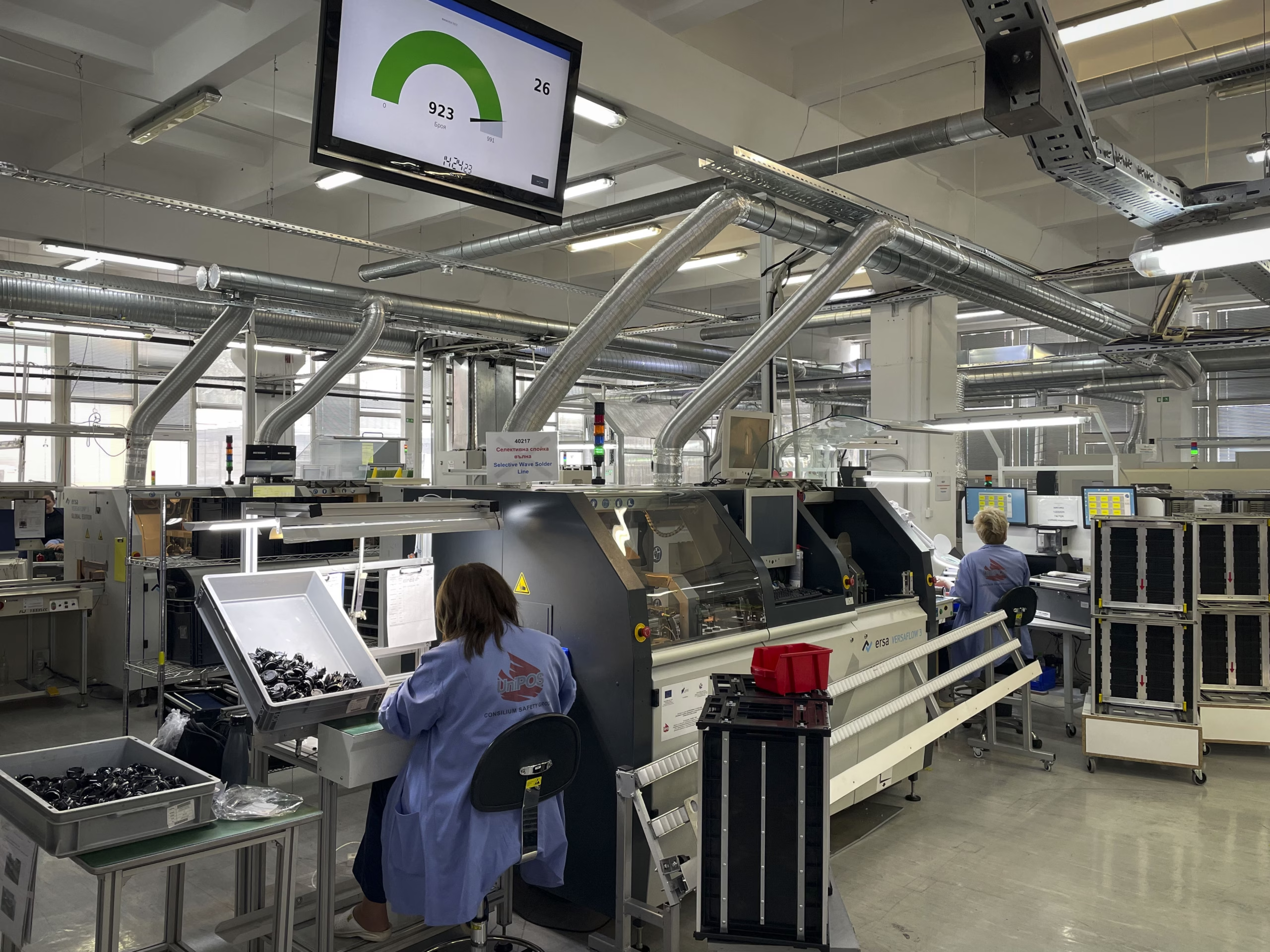
Steel arrives in large sheets. Plastic comes as granules. Electronic components are delivered in boxes filled with small parts.
Then, in a straightforward transformation, all of this becomes fire alarms, detectors and control panels, designed to sit quietly in the background of daily life and do their job.
Nearly all this work takes place in the same facility.
“We have built our production model over almost 30 years,” Dimitrov says. “Around 98 to 99 per cent of the materials are prepared internally.”
The factory has several main departments. Plastic injection moulding makes casings and parts for detectors. The mechanical department produces cabinets and small contact systems for detectors. There is also a powder-painting area that currently uses only one colour.
Reducing plastic waste at the source
In plastic injection moulding, much depends on the tools. When cold-runner systems are used, hardened plastic channels called sprues form during the process.
These are like the extra bits of biscuit dough left on a baking tray, not what you wanted, but always produced.
“This is really a waste,” Dimitrov explains. “Up to 25 per cent of that sprue can be reused, but the other 75 per cent must be sold to companies using mixed plastics for applications with lower quality requirements.”
In some designs, he adds, the sprue can be larger than the finished part itself. It is like buying a pizza and finding the box weighs more than the food.
UniPOS responded by implementing hot runner systems in new moulding tools. With this technology, molten plastic is injected directly into the mould cavity, removing the sprue entirely.
“By removing the sprue at the source, we reduce material loss,” Dimitrov says. “It lowers the need for both internal reprocessing and external handling.”
Using steel more efficiently
In the mechanical department, the main challenge is geometry. Cabinets and structural parts are cut from large steel sheets, and the placement of each piece affects the amount of material left over as offcuts.
“Before the optimisation, more than 40 per cent was waste,” Dimitrov says.
The offcut is not thrown away, Dimitrov explains. It is returned to suppliers but has little value because converting scrap into new sheets consumes significant energy and incurs higher costs.
To solve this, UniPOS teams redesigned the cabinets and changed how parts are arranged on the steel sheets.
They also introduced laser welding technology in September 2025, enabling smaller, well-placed parts to be joined into complete cabinets rather than stamping large shapes and discarding unused sections.
Dimitrov says the team was ready to produce the first batch that same month. “Preventing scrap in the first place is far more effective,” he says.
The cabinets produced at the site are primarily for UniPOS products, including fire alarm panels such as the 7000 M series and an extinguishing panel in the 5200 range. The full impact is expected to become clearer as volumes increase throughout 2026.
Keeping chemical processes in balance
Then there is the chemistry side of manufacturing, which reminds you that many vital processes use liquids you would not want to spill on your shoes. Soldering, galvanising and surface preparation before painting all rely on chemical baths whose composition must remain within narrow limits.
Over time, these mixtures change from their ideal state. The simplest solution would be to replace them.
Instead, UniPOS works with specialised partners to make them last longer. Samples from soldering are regularly tested in outside labs. When results change, suppliers recommend exact chemical adjustments.
Sometimes, part of the solution is removed, treated, and returned for reuse.
“The aim is to keep the process in balance for as long as possible,” Dimitrov says. “If that balance is lost, the entire material would need to be replaced.”
The same approach is used for galvanising, where careful control is required to achieve the correct coating thickness, including nickel plating. Any waste that cannot be recovered is collected and managed by partners.
People behind the processes
Technology alone does not drive these changes. Dimitrov describes a working culture where improvement is expected, but not always immediately accepted.
“Often the first answer is that something is impossible,” he says. “But after discussion and trials, we usually find a way.”
Teams work on process improvements beyond sustainability, including quality, automation and production time. Progress depends on collaboration rather than individual initiative.
“This is not a one-man show,” Dimitrov says. “It is teamwork. With most steps handled at the same facility, we can see the end-to-end production chain. That visibility makes it easier to spot losses early and fix them at the source”.
Looking ahead
The site plans to measure electricity use for each machine and production line. More detailed tracking will help assign energy costs to each product more accurately, especially in the plastics department, where machines draw 40-80 kW.
Additional moulding tools will be equipped with hot-runner systems. The painting department is also scheduled for an upgrade. Two new powder-painting chambers, one for white and one for multiple colours, are planned to reduce material losses from equipment used for over 20 years.
Dimitrov notes that the site currently uses only white for powder painting, and powder waste is one reason the upgrade is planned for next year.
Not all sustainability steps are currently possible. The buildings are rented, so on-site solar energy is limited.
“Our focus is on what we can influence directly”, Dimitrov says. “Improving processes, reducing waste and using materials more wisely”.
Read more about how sustainability is part of our vision here.


Talk safety with us
There are thousands of questions regarding safety. But there are also thousands of answers. Talk safety with us – we are ready when you are.